The full moon will undergo a dramatic transformation- dimming, changing shape, and eventually turning blood red.
Those who find themselves awake at 4 AM MST on Tuesday, March 3rd, will be treated to a spectacular total lunar eclipse- sometimes called a “Blood Moon” due to the rusty red color the moon takes when it passes through Earth’s umbral shadow. Because it is happening on March’s full moon, it is more specifically dubbed a“Blood Worm Moon”, referencing the spring planting season to come. Another total lunar eclipse will not be visible in the U.S until June of 2029, making this astronomical event worth rolling out of bed for.
A lunar eclipse lasts much longer than a solar eclipse, the whole event spanning nearly 6 hours from start to finish. Here are the highlights-
- 1:44 AM MST- the moon will appear to begin dimming as it enters the Earth’s penumbral shadow.
- 2:50 AM MST- Earth’s umbral shadow will become visible on the face of the moon, slowly advancing until the eclipse reaches totality.
- 4:04 AM MST- totality begins, and the moon will turn red due to the light that is refracted through Earth’s atmosphere.
- 5:02 AM MST- totality ends, and the process reverses.
- 6:17 AM MST- the moon leaves the Earth’s umbral shadow.
- 7:22 AM MST- the moon clears the Earth’s penumbral shadow, marking the end of the eclipse. (Yes, it will have already set behind the mountains in the West.)
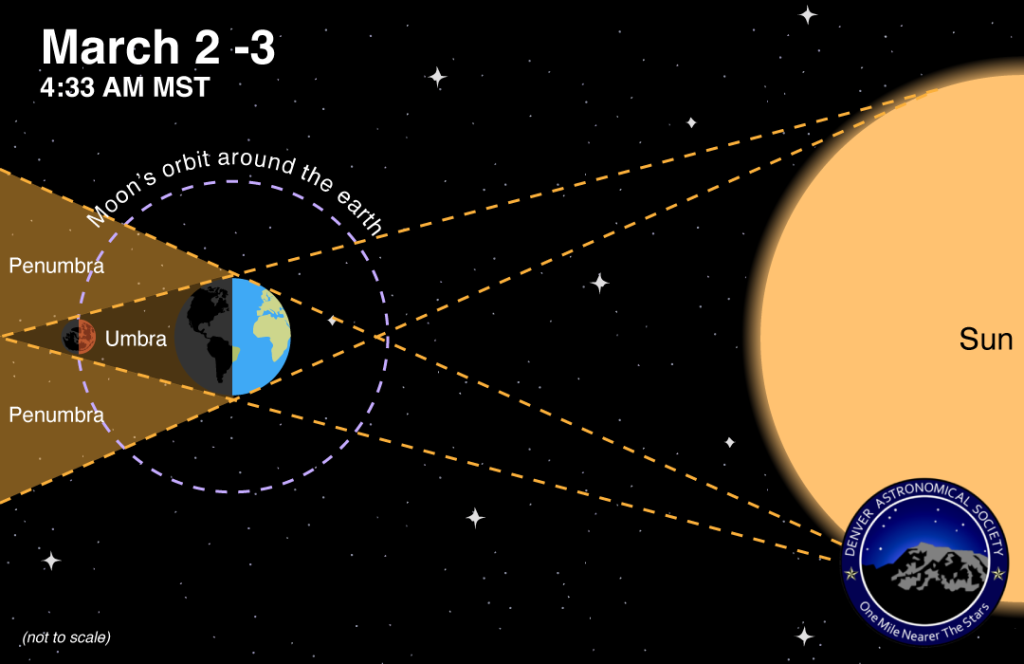
Humans have been mesmerized by these astronomical events for millennia. But what exactly is an eclipse, and what causes them?
An eclipse (or transit) is when one astronomical object casts a shadow onto another. On Earth, we experience solar and lunar eclipses. A solar eclipse occurs when the moon passes directly in front of the sun, casting a small shadow on the Earth’s surface. A lunar eclipse occurs when the Earth passes directly between the Sun and the Moon, casting a shadow on the Moon. The former occurs only on a new moon, and the latter only on a full moon. (There is a common misconception that the lunar phases are caused by the Earth casting a shadow on the moon, but this is not the case!)
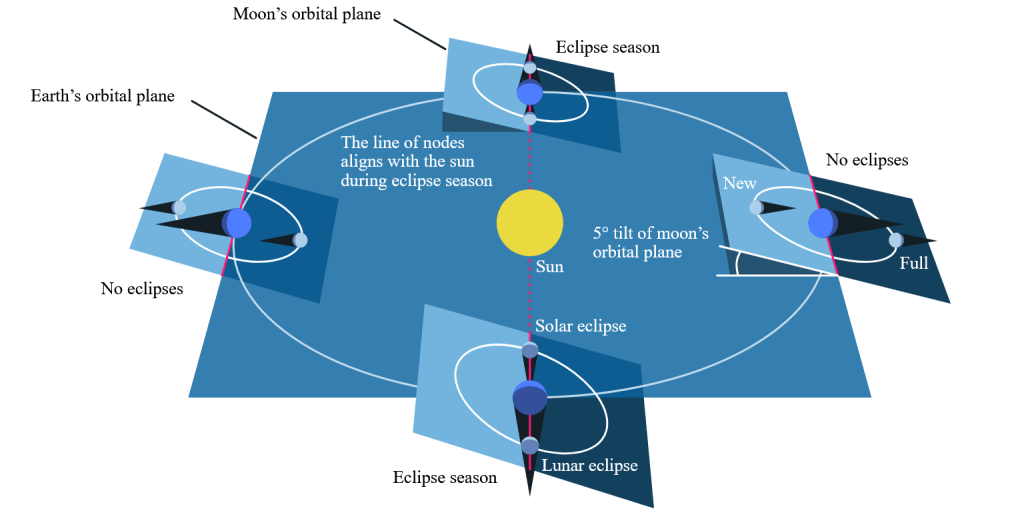
But why is there no eclipse at every new or full moon? This is because the moon’s orbit has a 5-degree tilt in relation to the ecliptic (the plane on which the Earth orbits around the sun). This means that the moon is usually slightly above or below the Earth during the vast majority of full/new moons. The points at which it crosses the ecliptic are called nodes, and when the moon is located at one of these spots, we call it an eclipse season. This period usually lasts around a month and occurs roughly two to three times a year, during which both solar and lunar eclipses are possible! Eclipses tend to follow a roughly 18-year pattern that is the result of multiple different astronomical cycles lining up (called the Saros cycle), meaning that a nearly identical eclipse will occur at approximately the same latitude every 18 years ( but at a different longitudinal location.)
Eclipses have always been a culturally significant event for humans, with interpretations ranging from omens of death and war to sacred times of rebirth and renewal. Regardless of context, eclipses are special events because millions of people pause their lives for a moment to collectively look up at the sky. So set an alarm, grab a picnic blanket and a pair of binoculars, and enjoy the show!