Ever pondered if college is worth the cost? You’re not alone. The U.S. is facing a crisis of confidence in its higher education system.
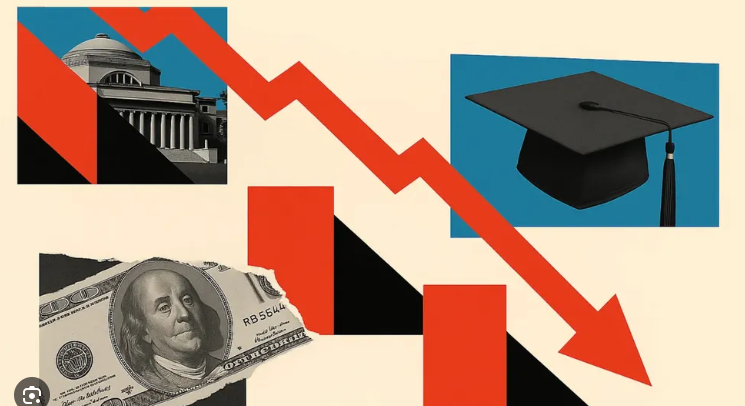
A recent survey from the Pew Research Center from October 2025 highlighted, “Seven-in-ten Americans now say the higher education system in the United States is generally going in the wrong direction – up from 56% who said this in 2020”. The survey cited tuition affordability and job-readiness as some of the factors that received unfavorable ratings from many citizens.
Ryan Warner, a host on the Colorado Matters podcast from Colorado Public Radio, mentioned in an episode from December 2025, in which he interviewed Reporter Lawrence Lanahan about jobs that don’t require a college degree, that “You don’t have to have a bachelor’s degree to work for the state of Colorado.”
In the interview, the two correspondents discussed how there were many job positions, from years ago, that once required a college degree, but no longer require a degree now. This, in turn, leads numerous people to believe that a post-secondary award is unnecessary for certain careers, making college a riskier investment in the public eye.
However, community colleges continue to play an important role in making post-secondary education appeal to students and serve practical needs.
Concentration on Workforce Readiness
Institutions like FRCC focus on getting students job-ready quickly, which is a contributing element to its success.

Student narratives, in particular – like those pictured around FRCC’s campuses- showcase how community colleges can launch people into employment, demonstrating the value of two-year institutions.
For instance, one poster at Westminster Campus spotlighted how a student named Matt earned an Associate of Applied Science in Computer-Aided Drafting, which allowed him to start working as a CAD specialist. Now, he instructs a class in 3DS Max, according to the feature.

Additionally, one story from the FRCC Blog spotlighted how a student named Laylonni Jaramillo started a career as an Emergency Medical Technician (EMT) after she graduated from the EMT certificate program at the Boulder Campus.
Lilian Clemente, the Executive Vice President & Chief Communications Officer of FRCC, professed, “sharing student stories that show a return on their investment has been pretty straightforward for us.”
Making Student Outcomes Visible
Besides marketing the college through student narratives, FRCC also tries to share data on student outcomes, such as how many students receive financial aid, and the average savings by attending a community college.
For example, on the institution’s home page, one figure claimed, “Nearly four out of ten FRCC students get financial aid”. Another datapoint revealed $21,166 in savings by attending the junior college for the first two years of a bachelor’s program.
Using this strategy could help improve the perceived quality of city colleges, thereby driving up enrollment at schools like FRCC.
Low Student Loan Borrowing Rates
There may also be other monetary factors at play that are boosting enrollment at junior colleges amid economic transformation. For one, reduced costs at these establishments translate to lower student loan borrowing. Clemente said, “Only 20% of FRCC students take out loans in an average year.”
Concurrent Enrollment Opportunities
Moreover, concurrent enrollment (CE) programs, like those offered at FRCC, strengthen community colleges’ appeal by allowing high schoolers to take college-level courses early, thereby earning college credit.
A profile piece from April 2025, by the Colorado Community College System (CCCS), revealed how a CE program shaped the educational path for an individual named Lizzie Homer, who is now a full-time student at Arapahoe Community College.
To showcase the wide selection of classes that some CE programs offer, authors noted that Homer took courses in “a diverse range of subjects: mathematics, business, English composition, creative writing, health and nutrition, and psychology.”
Homer nearly completed her associate’s degree while still in high school. The report from CCCS proclaimed, “By the time she graduated high school—a semester early in December—she had already completed approximately 60% of her associate degree requirements.”
Despite weakening optimism towards America’s institutions of higher learning, community colleges still play a crucial role in society, by giving students reasonably priced education, the chance to obtain essential workforce skills, and the possibility to receive college credits earlier than some people.
