By Nyxi Gammieri
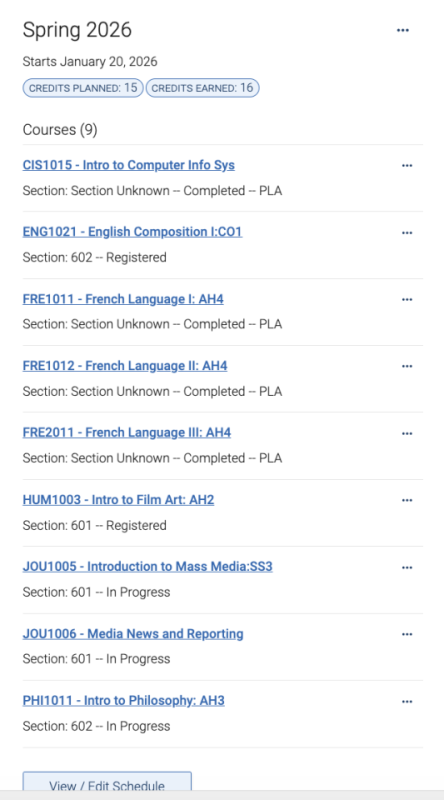
When I explained to a first-year classmate how my academic plan had changed so dramatically — that what I expected to be two years at FRCC was shaved down to three semesters in a flash — it was met with disbelief.
“How is that even possible?”
It sounds unrealistic. It isn’t. It came down to four letters – CLEP – and a whole lot of life experiences.
“CLEP?”
The acronym stands for College Level Examination Program. It allows students to earn college credit by passing a single exam instead of completing an entire course.
I took two CLEP tests, and the result was astounding.
The concept behind it:
If a student already knows the material — whether from previous classes, work experience, or independent study — the person can demonstrate it on a test and receive credit toward a degree.
A student could take one of 34 exams from five CLEP categories: Composition and Literature, World Languages, History and Social Sciences, Science and Mathematics, and Business.
Through those two exams, I earned 16 college credits — yes, 16 — for a fraction of the cost of traditional coursework.
The equivalent classes would have taken months — nearly three full semesters —and cost thousands of dollars.
Programs like this offer something simple but powerful: a way to move through college based on what one knows, not how long a student sits in a classroom.
But here’s the problem: Instead of being presented as core options, CLEP advancement is treated like a side note — if it’s mentioned at all.
From my advisor, I got, “There’s CLEP, too — if you think that will help.”
If that helps? It was like finding a gold mine.
When people picture college students, they often imagine 18-year-olds just out of high school. But that image doesn’t reflect reality.
Classrooms today have students in their late 20s, 30s, 40s, and beyond.
They return to school, change careers, or finish what life paused them from doing. For many, time isn’t flexible. It’s limited.
And still, the system doesn’t prioritize giving them tools to move faster.
Even when the information exists, it’s often buried. On the FRCC website, for example, credit-by-exam options are placed under “Academic Support.” But why would a student think to look there? Why would folks trying to plan their degrees — or avoid unnecessary classes — go searching under a category labeled “support”?
That placement sends a message, whether intentional or not. It frames these options as secondary matters, even remedial — rather than what they actually are: strategic tools that significantly reduce the cost and length of college.
And CLEP isn’t the only option. There’s also DSST, a similar credit-by-exam program originally developed for the military but now available to civilians. Like CLEP, it offers exams across a range of subjects and provides another pathway for students to convert existing knowledge into academic progress.
Many institutions offer portfolio-based credit, prior-learning assessments, and other ways to translate real-world knowledge into academic progress. These pathways recognize something the system often overlooks — learning doesn’t only happen in classrooms.
But instead of being treated as essential, they remain hidden.
In a system where students are expected to make major financial and time commitments, failing to present these options clearly isn’t neutral. It directly shapes outcomes. It determines how long students stay enrolled, how much they pay, and how efficiently they move forward.
There’s a version of this system where advisors actually advise — where they don’t just help students navigate a non-intuitive portal but actively point them toward the most efficient path. Where options like CLEP and DSST are introduced early, clearly, and deliberately.
Because why wouldn’t they be?
Why wouldn’t students be told from the beginning that they could spend around $100 on an exam and potentially save months and thousands of dollars? Why wouldn’t that be standard information?
Instead, this knowledge spreads through chance conversations — between classmates, in passing, or long after it would have made the biggest difference.
When something has the potential to save people months — or even years — of their time, it doesn’t belong in the margins.
It belongs at the center of the system.
At its core, this isn’t just about exams or credits. It’s about access to information — and who gets it in time to benefit from it.
If higher education is meant to create opportunity, then transparency shouldn’t be optional. The tools already exist. The knowledge is already there.
The only question is why students are still expected to find it on their own.