THIS IS PART ONE OF A TWO-PART SERIES!
Each semester at Front Range Community College comes with fresh classes, new faces… and the same technology troubles. As students and faculty settle into the fall term, many are once again running into slow Wi-Fi connections and frequent problems with Desire2Learn (D2L), the online learning platform used for nearly every class on campus.
For many at FRCC, the pattern is familiar. During the first few weeks, the school’s servers seem to buckle under the weight of thousands of students logging on at once. Pages freeze, connections drop, and even the simplest online tasks can take minutes. Eventually, things tend to settle down, but the damage is already done: valuable class time is lost, assignments are delayed, and frustrations rise.
The biggest pain point is D2L. Teachers rely on it to post assignments, open presentations, and guide students through lessons. When it doesn’t load, everything stalls. Some classes lose the first five minutes or more, simply waiting for the system to catch up. Over the course of a semester, that wasted time adds up to hours that could have been spent learning.
Students feel the impact outside the classroom as well. D2L is the hub for quizzes, homework submissions, announcements, and grades. When it won’t load, deadlines can be missed, or students are forced to scramble for alternatives. Many resort to using their own phone data because it’s faster than relying on the school’s Wi-Fi. However, not every student can afford the extra cost, and those without unlimited data plans are left with limited options.
Unstable Connection: School Wi-Fi Speeds All Over the Map
A series of ten Wi-Fi speed tests conducted around the Westminster campus reveals an unstable network, with performance swinging from nearly unusable to impressively fast depending on location and time of day. The tests were run using standard internet speed tools, measuring both download and upload performance at various points across the school.
Reliable Wi-Fi is no longer just a convenience; it’s a necessity. Nearly every course at FRCC depends on online tools for learning, whether it’s D2L, research databases, or even email. Without dependable internet, students can’t fully engage with their classes, and instructors can’t deliver their lessons effectively.
Download speeds, which determine how fast users can stream videos, load websites, or download files, within these tests ranged from a sluggish 1.8 Mbps to a strong 88.3 Mbps. Upload speeds, important for sending assignments, uploading media, or joining video calls, varied just as wildly, from 0.03 Mbps to 59 Mbps. In several early tests, speeds dipped so low that even basic online tasks like checking email or opening a webpage would have been difficult. Later tests, however, showed brief moments of high performance, suggesting that the system is capable of strong speeds but struggles to maintain them consistently.
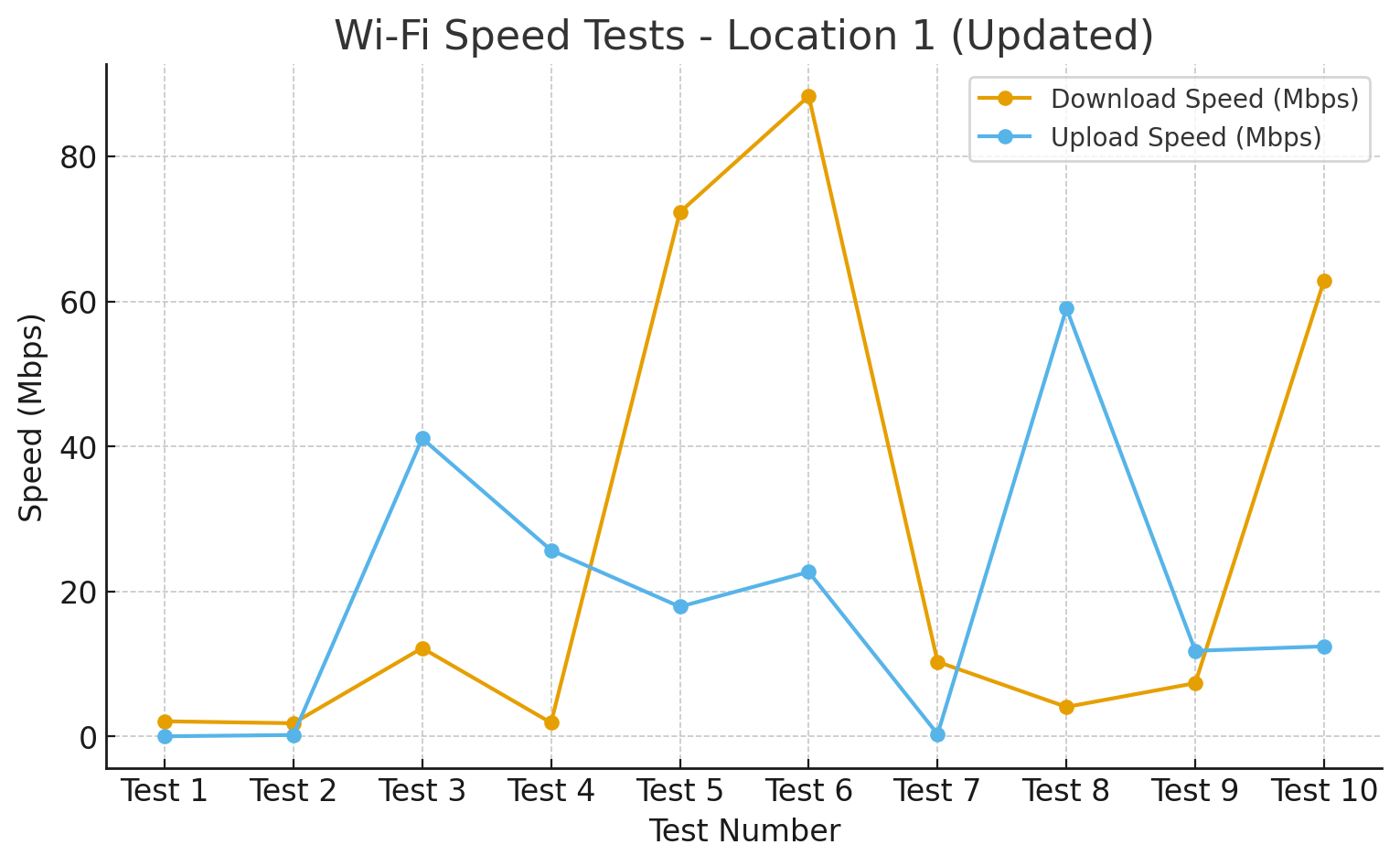
This inconsistency points to a few likely explanations. One major factor could be uneven router placement throughout the school, meaning some classrooms or hallways have much stronger signals than others. Another issue may be network congestion, with hundreds of students and staff online simultaneously, the available bandwidth gets divided among users, causing noticeable slowdowns during peak hours. Additionally, older access points or outdated hardware can cause bottlenecks in parts of the building, especially if newer devices are connected to older infrastructure. Several factors may contribute to the inconsistent Wi-Fi performance at FRCC.
Upload performance was especially unpredictable. Some tests recorded virtually no upload capacity, making cloud storage, file submissions, or live collaboration nearly impossible. Other tests, however, saw speeds comparable to home broadband networks. This sharp contrast indicates that different routers or access points might be configured inconsistently, a common issue in large networks that have been expanded or upgraded over time without full standardization.
When comparing all ten tests, one clear pattern emerges: the school’s Wi-Fi can perform well, but its reliability is its weakest point. For students trying to complete assignments online, attend virtual meetings, or simply research between classes, the network’s instability can cause serious frustration and lost productivity.
The data ultimately shows that the school’s network doesn’t just need more speed, it needs balance and stability. Whether that means reconfiguring access points, upgrading equipment, or improving load distribution, the issue deserves attention. Consistent, dependable Wi-Fi isn’t a luxury in a modern learning environment; it’s a necessity.
We know which times of the school year tend to get the most crowded. If you visit the Westminster campus around lunchtime on a Wednesday, you can expect the Wi-Fi to be pretty unpredictable. But come by on a quiet Friday, and you’ll notice a big difference. The connection suddenly feels faster and more reliable, so it makes you wonder, why can’t it be like that all the time?
Luke Springfield, who is a part of the IT department here at the Westminster campus, said about a request for further information, “I needed to escalate this request [for information] internally. I’ll let you know when I hear back.”
Until then, the hope is that the system will stabilize as it has in past semesters. But each new wave of students raises the same question: why should slow Wi-Fi and D2L failures be treated as a normal part of the FRCC experience? If education continues to move further online, it may be time for the college to make lasting improvements instead of waiting for the servers to “cool down.”

