Colorado may not have been in the path of complete totality for the solar eclipse last Monday, but that didn’t stop the dozens of students and staff on FRCC’s Westminster Campus from congregating at the viewing event hosted by the College Hill Library and the campus’s Science Club for said eclipse, which was held at entrance two just outside the rotunda.
A shipping box full of specialized glasses, of which there were many different designs, were available for those who attended the event to borrow; however, they were not allowed to keep these glasses and had to return them upon leaving. The glasses were provided by the Planetarium of the Denver Museum of Nature and Science, which the College Hill Library acquired these glasses from to provide for the event.
The event was far from silent as much chatter could be heard outside. Despite this chatter, there was no discussion planned for the event: it was simply a viewing event. Many students only briefly viewed the eclipse, especially as the event wore on, and these students would return the glasses after they were satisfied from the view of the eclipse. Some students even took pictures on their phones of the eclipse from the point of view of the glasses themselves.
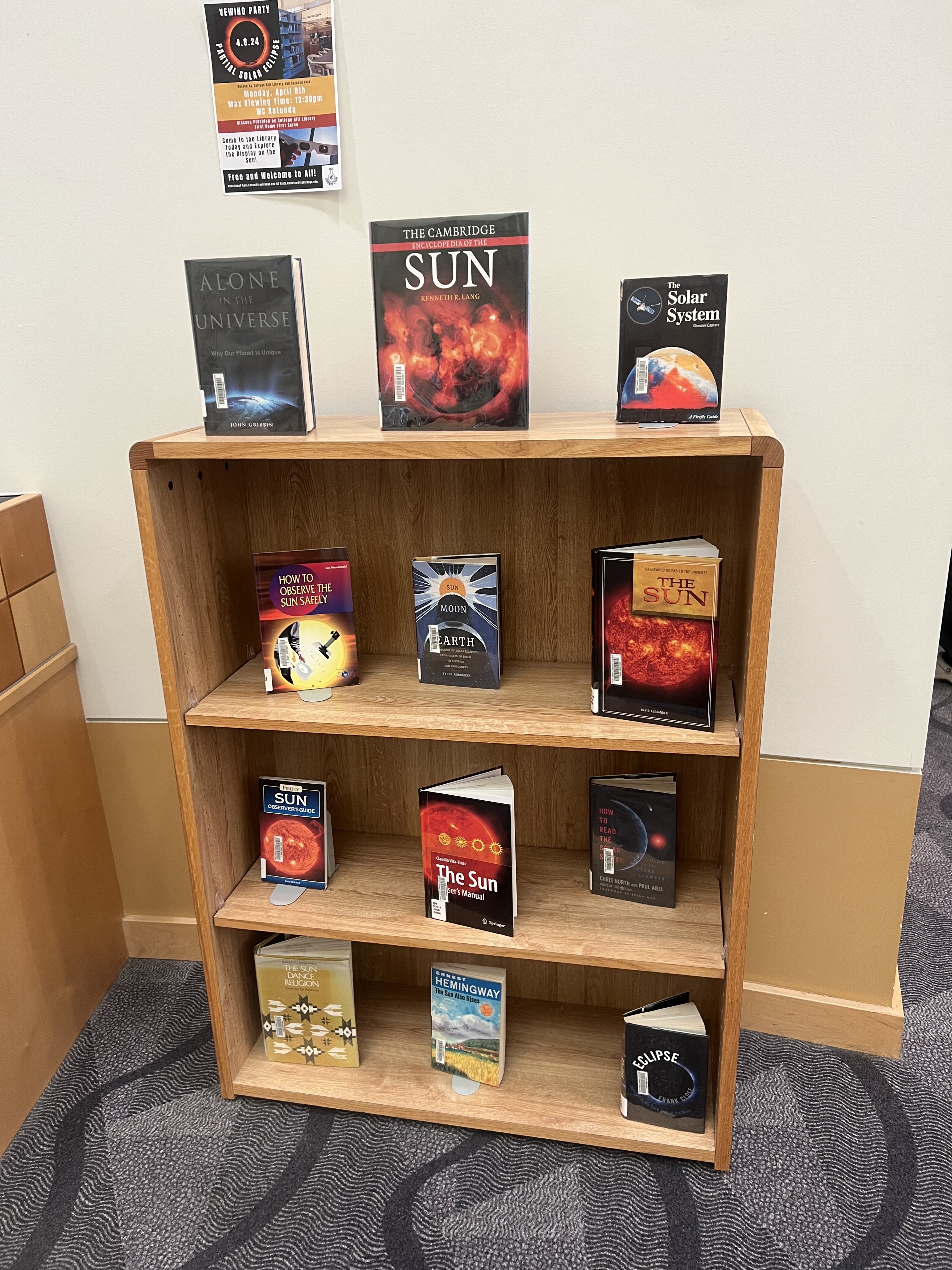
The Science Club and the Library have collaborated for several events in the past and will continue to do so for future events, such as a book discussion planned for the fall. The viewing event marked yet another such collaboration. One such piece of evidence of this was a large exhibit in the Library displaying primarily non-fiction books discussing the Sun, the Solar System or solar eclipses, but some fictional titles were supplied also.
Faith Christen, the president of the Science Club, said Kara Lucas, the Public Services Librarian at the College Hill Library, “has been really great about coming to our [Science Club] meetings and presenting a lot of creative ideas to us. One of the ideas she brought up was of this solar eclipse viewing party and I have to be honest: Kara did a really great job of getting all of the glasses put together.”
The Science Club did play a part in this event, of course. Christen said that the Club’s role was in “making a flier and distributing that flier and kind of trying to bring people to the event. But I think with such a great event as a solar eclipse, there isn’t much marketing needed, right? People will just kind of gravitate outside to see it.”
This sort of natural wonder to a natural phenomenon such as an eclipse was also a feeling Kara Lucas had. From the eclipse, she felt “[amazed] by the chances, a feeling of vastness of the universe, a sense of mystery. There’s so much we don’t know.”
Christen herself thought “it’s great just to come out and spend 15 minutes, half an hour to view the event. It doesn’t take much extraneous power to do so and so I think it’s something that everyone should try to be involved in if their schedule allows. And, um, in 20 years personally, I hope that I’m in a point in life where I can travel the path of totality, you know, take a week off of work and just travel the moon.”
Students were not allowed to keep the glasses as they were in “limited supply, so there was 48 glasses that the Library got all together … it was first come, first serve and then after that you would get a recycled pair, and I think that’s worked nicely. Everyone was able to view the eclipse at least once,” according to Christen. This policy was upheld as the lone student holding up the box of glasses had to explain to students who asked if they could keep the glasses that they weren’t able to do so.
This student, who explained that he had volunteered to hold up the glasses from his own interest in astronomy, was not associated with the Library or the Science Club. Many students also inquired about if they had missed the maximum totality of the partial eclipse after it had occurred as they were viewing the eclipse, and the student providing the glasses informed them that they had. Most of the students and faculty who were present had dispersed and walked inside at around 12:45, 15 minutes past the listed maximum totality on the posters advertising the event.
At this point, there were only a few sparse individuals gazing at the eclipse, including this student. Some of those few individuals who did took a pair of eclipse glasses, and some of these showed up past 1:00 pm, a time when classes are usually back in session for the majority of the Westminster campus.

Faith Christen had also thought the event “a great opportunity” for promoting the Science Club and future events, excitedly explaining that “[there’s] a lot of students who come just to see the solar eclipse and may not be aware of student organizations on campus that have part in planning some events, whether it’s planning the solar eclipse viewing or some other events that we have going on.”
She also expressed enthusiasm for the large gathering of FRCC’s students and staff attending the event, saying that “I saw, you know, some faculty having really nice times together viewing the eclipse. So I think it’s just a really great event for everyone to be involved in.”
Reporting assistance from Isabel Delgado


